
Root Canal Treatment Explained
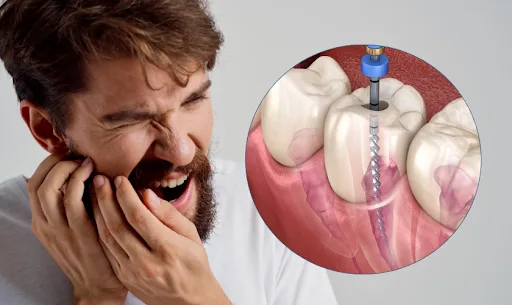
The Pain That Brings You In
It usually starts as sensitivity — a sharp jolt when you drink something cold, a dull throb that wakes you at night. Then it gets worse. The ache becomes constant, your gum swells near the tooth, and painkillers barely take the edge off. By this point, the problem is no longer in the enamel or the filling — it has reached the nerve inside your tooth.
What Is Happening Inside the Tooth
Every tooth has a soft core called the pulp, which contains nerves, blood vessels, and connective tissue. When deep decay, a crack, or repeated dental work breaches the protective layers, bacteria reach the pulp and trigger infection. Left untreated, this infection can:
- Destroy the nerve, killing the tooth from the inside
- Form an abscess at the root tip, spreading infection into the jawbone
- Cause referred pain that radiates to your ear, temple, or opposite jaw
A root canal removes the infected pulp, eliminates the bacteria, and seals the tooth — preserving the natural structure instead of extracting it.
Step by Step: What the Procedure Involves
At Enbite Multi-speciality Dental Studio, Dr. Bharti Bhadoria uses modern rotary instruments and precise diagnostic imaging to perform root canals with minimal discomfort:
- Diagnosis & Imaging — X-rays confirm which tooth is affected and how far the infection extends. This determines the number of canals to treat and their curvature.
- Anaesthesia — The tooth and surrounding area are completely numbed. Most patients report feeling no pain during the procedure — only vibration and pressure.
- Access & Cleaning — A small opening is made in the crown. Specialised rotary files navigate each canal, removing infected pulp tissue and shaping the walls for a clean seal.
- Disinfection — The canals are flushed with antimicrobial solutions to eliminate remaining bacteria in microscopic spaces the instruments cannot reach.
- Filling & Sealing — The cleaned canals are filled with a biocompatible rubber-like material (gutta-percha) and sealed to prevent re-infection.
- Restoration — A crown is typically placed over the treated tooth to restore its full strength and protect it from fracture.
The entire process takes one or two appointments, depending on the complexity of the case.
The Reputation vs the Reality
Root canals have an outdated reputation for being painful. The truth is the opposite — the procedure relieves pain. The infection inside the tooth is what causes the agony. Modern anaesthesia and rotary instruments make the actual treatment comparable to getting a filling.
Most patients say the same thing afterward: “That was nothing like what I expected.”
Why Saving the Tooth Matters
Extraction is always an option, but it comes with trade-offs:
- Adjacent teeth shift into the gap over time, changing your bite
- Bone loss begins at the extraction site within months
- Replacement costs more — An implant or bridge to fill the gap is a larger procedure than the root canal that could have saved the tooth
A successfully treated tooth can last decades with proper care. It is your own tooth, anchored in your own bone, functioning naturally.
Signs You Should Not Ignore
Book an evaluation if you notice:
- Lingering sensitivity to hot or cold that does not fade within seconds
- Spontaneous pain — throbbing that starts on its own, especially at night
- Swelling or a pimple on the gum near a specific tooth
- Darkening of a tooth — a sign the nerve may be dying
- Pain when biting down on a particular tooth
These do not always mean you need a root canal, but they always mean something needs attention.
Do Not Wait for the Infection to Spread
Tooth infections do not resolve on their own. Antibiotics may temporarily reduce symptoms, but without removing the source of infection inside the canal, the problem returns. At Enbite Multi-speciality Dental Studio in Akota, Vadodara, Dr. Bharti Bhadoria provides precise endodontic care designed to save your tooth, stop the pain, and protect your long-term dental health.
If a tooth is too damaged for a root canal, extraction may be the next step. For teeth that need structural rebuilding after treatment, explore our restorative dentistry options. See all dental treatments at Enbite or learn about Dr. Bharti’s expertise. Ready to address your tooth pain? Book an appointment with Dr. Bharti Bhadoria.