
Cavity Treatment & Early Fillings
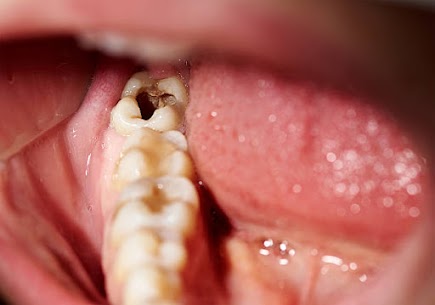
A Cavity Does Not Announce Itself
That is the problem. By the time you feel pain, sensitivity, or notice a dark spot, the decay has already eaten through enamel and is working into the softer dentin underneath. Cavities are silent in their early stages — which is exactly why regular check-ups catch what you cannot feel.
How a Cavity Forms
Your mouth is home to bacteria. Every time you eat — especially sugary or starchy foods — these bacteria produce acid. That acid attacks your enamel, the hard outer shell of your tooth. Over time:
- Demineralisation — Acid dissolves minerals from the enamel surface, creating a weak spot
- Enamel Breach — The weakened area collapses into a small hole — this is the cavity
- Dentin Invasion — Decay spreads faster in the softer dentin layer, widening beneath the surface
- Pulp Threat — If untreated, bacteria reach the nerve, causing infection and pain that may require a root canal
The image above shows a molar where decay has already broken through the enamel and hollowed out a significant portion of the tooth. At this stage, a simple filling may still save it — but waiting longer risks losing the tooth entirely.
What Modern Cavity Treatment Looks Like
Gone are the days of conspicuous silver amalgam. At Enbite Multi-speciality Dental Studio, Dr. Bharti Bhadoria uses tooth-coloured composite resins and modern bonding protocols:
- Decay Removal — The infected portion is carefully drilled away, preserving as much healthy tooth structure as possible
- Bonding Agent — A conditioning liquid is applied to help the filling material grip the tooth walls
- Composite Layering — The resin is placed in thin layers, each hardened with a curing light for maximum strength
- Shaping & Polishing — The filling is sculpted to match your bite and polished smooth so it feels natural
The result is a restoration that blends invisibly with your tooth — no metallic flash when you laugh.
Types of Fillings and When Each Is Used
| Type | Best For | Durability |
|---|---|---|
| Composite Resin | Visible teeth, small to medium cavities | 5–10 years |
| Glass Ionomer | Areas near the gumline, children’s teeth | 3–5 years |
| Ceramic/Porcelain | Larger restorations needing strength and aesthetics | 10–15 years |
| Indirect (Inlay/Onlay) | Extensive decay where a full crown is not yet needed | 10–20 years |
Dr. Bhadoria selects the material based on the cavity’s size, location, and the forces that tooth handles during chewing.
Why Early Intervention Changes Everything
The difference between catching a cavity early and catching it late:
- Small cavity → 20-minute filling, local anaesthetic, minimal cost
- Medium cavity → Larger filling or inlay, possible sensitivity afterward
- Deep cavity → Root canal treatment, crown, multiple appointments, higher cost
- Too late → Extraction, followed by an implant or bridge to replace the tooth
Every stage costs more time, money, and tooth structure than the one before it. The cheapest filling is always the first one.
Preventing the Next Cavity
After treatment, a few habits keep new cavities from forming:
- Brush twice daily with fluoride toothpaste — fluoride actively remineralises weak spots before they become cavities
- Floss once daily — Cavities between teeth are the ones you never see coming
- Limit snacking frequency — It is not just what you eat but how often. Every snack triggers a new acid attack
- Drink water after meals — Rinses acid and food particles away from tooth surfaces
- Keep your check-up schedule — Every six months, so small problems stay small
Do Not Wait for the Pain
If you have not had a check-up in over a year, there may be a cavity developing right now that you cannot feel. At Enbite Multi-speciality Dental Studio in Akota, Vadodara, Dr. Bharti Bhadoria uses precision diagnostics to catch decay at its earliest stage — when treatment is quickest, least invasive, and most effective.
If a cavity has already reached the nerve, learn about root canal treatment. When a tooth cannot be saved, read about when extraction is the right call. For children, building healthy habits early is the best prevention. Explore all dental treatments at Enbite or learn more about Dr. Bharti Bhadoria. Schedule your check-up today.